


How to Mail a Postcard
Table of Contents
- Introduction
- What Qualifies as a Postcard?
- Step-by-Step Guide to Mailing a Postcard
- Postcard Addressing, Stamps, and Postage Requirements
- Mailing International Postcards
- Mailing Postcards for Businesses
- Common Postcard Mailing Mistakes to Avoid
- Key Takeaways
- Conclusion
Mailing a postcard is quick and easy, whether it’s for personal or business purposes. But before you drop your postcard into the mailbox or head to the nearest post office, it’s important to understand a few basics first.
This PrintRunner guide covers postcard mailing essentials, including addressing and postage requirements, international shipping, and bulk mail campaigns.
What Qualifies as a Postcard?
Not every printed card instantly qualifies as a postcard. Size, shape, and thickness all affect postage rates and eligibility.
According to current United States Postal Service (USPS) guidelines, for a print product to be mailed at the postcard rate, it should meet the following requirements:
- It should be rectangular
- Should measure between 5” and 6” long
- Should be between 3.5” and 4.25” high
- Should have a thickness between 0.007” and 0.016”
If your postcard exceeds these requirements, you may be charged at letter rates instead.
Not sure which size to go for? Read our guide on Standard Postcard Sizes.
Step-by-Step Guide to Mailing a Postcard
If you’re mailing a postcard for the first time, follow these easy steps:
- Design or select your postcard. Choose your postcard and ensure it meets postal size requirements to qualify for standard postcard rates. Check the card for stains, damages, and that it’s durable enough for mailing.
- Write your message. Whether it’s a promotional or personal message, make sure that your message is easy to read and the text is written in the right area of the postcard. Need help with writing postcards? Our How to Write Postcards article has got you covered.
- Address the recipient correctly. Write the recipient’s address on the designated side. Double-check for spelling, street numbers, and ZIP codes to avoid errors and delivery issues.
- Apply the appropriate postage. Order the stamp and place it in the upper-right corner. If you’re not sure about postage requirements, check your local post office or USPS’s postage rates and prices.
- Drop it in a mailbox or bring it to the post office. Once addressed and stamped, put the postcard in a mailbox, postal collection box, or drop it off at the post office.
Looking for more affordable ways to print postcards before mailing them? Check out our article on How to Make Quality Postcards That Don’t Break the Bank.
Postcard Addressing, Stamps, and Postage Requirements
Proper addressing and postage are essential when mailing postcards. Postal systems rely on clear and accurate addressing to ensure a successful delivery.
Where to Write the Recipient’s Address
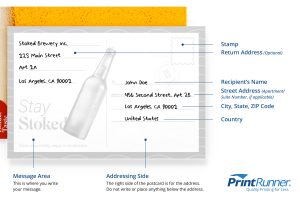
The recipient’s address is usually written on the right side of the postcard’s back. It includes:
- The recipient’s name
- Street address
- Apartment or suite number if applicable
- City, state, and ZIP code
- Return address (optional; written on the upper-left area)
Where to Place the Stamp
The postage stamp is always placed in the upper-right corner of the address side. This location helps automated sorting machines to easily identify and process the mail efficiently.
- x. .,
If you want to learn more about address formatting, check out our How to Address a Postcard guide for examples, layout tips, and addressing best practices.
How Much Postage Is Required?
Postage rates depend on several factors:
- Postcard size
- Weight
- Destination
- Mailing class
USPS currently lists standard domestic postcard postage at $0.61, while international postcard postage depends on destination and current postal rates.
When Additional Postage May Be Needed
Sometimes, extra postage may be required for your postcard if:
- It exceeds standard dimensions
- It uses specialty materials
- It includes unusual folds or attachments
- It’s mailed internationally
Learn more about postage rates here.
Mailing International Postcards
Mailing postcards across town is different from mailing ones across the world. If you’re mailing postcards internationally, it requires additional requirements such as:
- Country-specific address formats
- International postage rates
- Customs requirements in some situations
- Language and formatting differences
Remember to check USPS’s destination-specific guidelines before mailing to prevent delays.
Delivery Times and Tracking Expectations
Delivery times vary depending on the destination and postal service capacity.
| Mailing Type | Typical Delivery Window |
|---|---|
| Domestic | 1-5 business days for postcards |
| International (Nearby Countries) | 1-3 weeks |
| International (Long-Distance Destinations) | Several weeks |
Standard USPS First-Class Mail domestic and international postcards do not include a tracking number. To track your postcards domestically or internationally, you need to pay for additional services, such as Certified Mail (domestic) and Registered Mail (international).
Mailing Postcards for Businesses
Postcards are not limited to personal use; businesses can also use them for direct mail marketing purposes. Below are ways you can mail business postcards:
Direct Mail Services
If your business wants to target specific individuals or households, consider Direct Mail Services. This mailing option is list-driven and sends your marketing mail based on demographics, behavioral data, or customers’ buying history.
PrintRunner offers Direct Mail Services that save you time and handle all the heavy lifting from design and printing to mailing — no need to go to the post office!
Here’s how to get started:
- Customize your postcards. Choose the material, size, and colors.
- Select the quantity. Direct Mail has a minimum of 250 postcards per order.
- Check the “Add Mailing Services” prompt. Then click “Continue”.
- Upload your mailing list to the mailing services section. Make sure it’s saved as XLS, XLSX, or comma-separated CSV files.
- In the mailing options section, choose the number of postcards to be mailed, forwarding options, mailing date, and postage.
- Proceed to checkout.
Every Door Direct Mail (EDDM) and Bulk Mailing Options
EDDM is a mailing option for businesses targeting specific neighborhoods or geographic areas. Instead of delivering mail to specific individuals, it delivers postcards within selected postal routes and does not require a mailing list, making it more affordable. There are two ways you can do to mail EDDM postcards:
Method 1: EDDM via USPS
- Sign up or use an existing USPS account.
- Choose the neighborhoods and audience you want using the EDDM Online Tool.
- Design and print your postcards.
- Select your drop-off date and payment type.
- Print all postal service forms and attach the EDDM slip to your mailing bundles.
- Drop off or ship your mail to the post office.
Method 2: PrintRunner’s EDDM Service
- Select Print and Mail in the EDDM postcards product page.
- Choose your preferred mailing date and route.
- Upload your artwork.
- Complete checkout.
- PrintRunner will handle all the printing, bundling, processing, postage, and delivery to the post office.
Bulk mailing is a mailing option to consider if you want to reduce costs for larger campaigns while streamlining distribution.
Common Postcard Mailing Mistakes to Avoid
Postcard delivery issues often come from small mistakes. Common errors include:
- Using the wrong postage amount
- Writing incomplete addresses
- Forgetting apartment or suite numbers
- Choosing a postcard size that doesn’t meet postal standards
- Placing text in areas reserved for postal processing
- Overcrowding the design with too much information
These small mistakes can still affect postcard delivery and campaign performance. Successful postcard mailing requires attention to detail. Use high-quality materials, double-check addresses, choose the right size, and ensure proper postage before mailing. This way, you’ll save time and avoid unnecessary costs.
Key Takeaways
- Proper addressing, postage, and formatting help ensure successful delivery.
- Domestic and international postcard mailing have different requirements, costs, and delivery timelines.
- Businesses can use postcards for promotions, direct mail campaigns, and local marketing.
- Understanding postcard size requirements can help you avoid extra postage fees.
- This guide links to resources covering postcard printing, writing, mailing, and marketing best practices.
Mail With Confidence
Now that you have a better understanding of how postcard mailing works, you’re ready to take the next step. Use these resources in this guide to learn more about postcard design, printing, postage, international mailing, and direct mail marketing so you can create and send postcards with confidence.